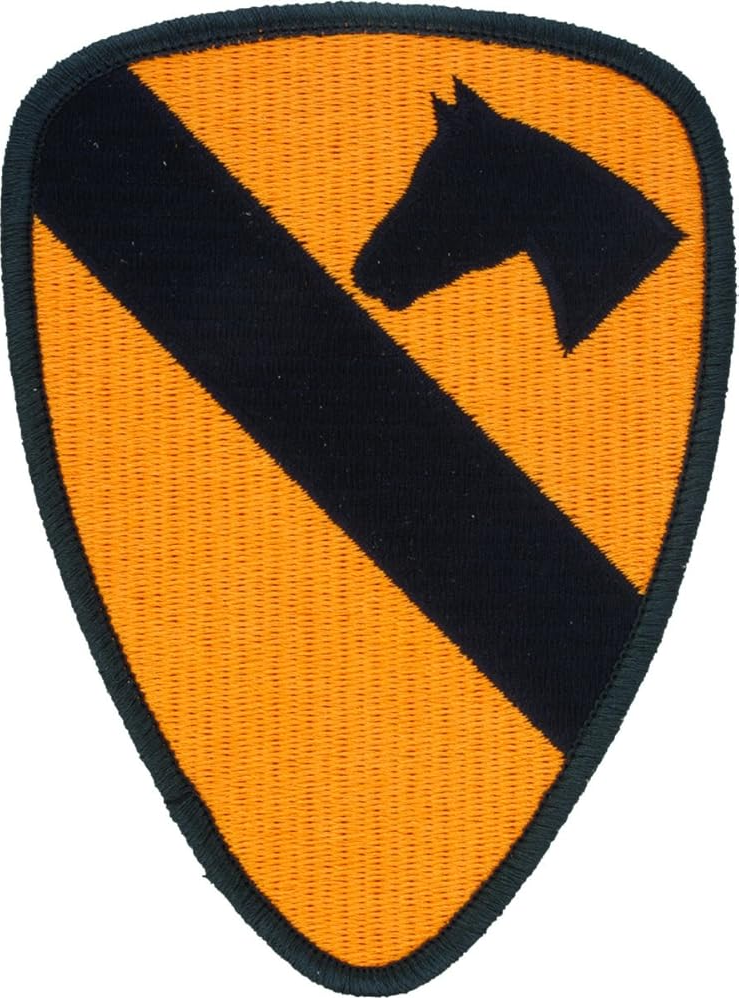
The Cambodian Incursion — D Company in the Fishhook (May–June 1970)
The Cambodian Incursion — D Company in the Fishhook
Context page — operation level (umbrella). Built from the U.S. Army Center of Military History's airmobility volume, with the 2/8 Cavalry firebase records and the Army's Illingworth account confirming the battalion's role. It frames D Company's 1970 in and around Cambodia — the year the First Team carried the war across the border. The campaign's shape is thoroughly documented at division and brigade level; the company's day-by-day actions, and the specific contacts behind the year's casualties, await the battalion staff journal and are documented on their own event pages as they are built.
What it was
The Cambodian Incursion (1 May – 30 June 1970) was the 1st Cavalry Division's defining operation of 1970 — and the first time a large U.S. airmobile force fought outside the borders of South Vietnam. For nine years the Viet Cong and North Vietnamese had run their war in III and IV Corps from sanctuaries just inside Cambodia: a network of base camps housing the Central Office for South Vietnam (COSVN) and a vast, truck-supplied logistics complex of warehouse caches that allied operations like Junction City and Attleboro had never been allowed to reach. By early 1970 the 1st Cavalry — straddling the infiltration trails out of Cambodia toward Saigon across a 14,000-square-kilometer area of operations — had pushed its small, hasty fire bases right up to the border, certain that the warehouses feeding those trails lay just beyond it.
On 26 April 1970, MG Elvy B. Roberts was ordered to plan a coordinated attack into the "Fishhook" of Cambodia. The U.S. operation — officially Operations TOAN THANG 43, 45, and 46 — opened on 1 May behind B-52 strikes and massed artillery. Task Force Shoemaker, under the division's Assistant Division Commander for Maneuver, BG Robert M. Shoemaker, made the assault: the 3rd Brigade, 1st Cavalry (with attached mechanized infantry and tanks), the 3rd ARVN Airborne Brigade, and the 11th Armored Cavalry Regiment, with the 1st Squadron, 9th Cavalry screening. Tactical surprise was complete. Over the next weeks the cavalry overran "The City" (a three-square-kilometer storage depot found by C Co, 1/5 Cav on 5 May) and "Rock Island East" (329 tons of munitions, found by the 2nd Brigade on 8 May), and a chain of smaller caches. COSVN's headquarters was never found, but the supply system feeding the enemy's war in the south was gutted: by the time the last U.S. aircraft left Cambodia at 1523 on 29 June 1970, the division (with attached units) had accounted for 2,574 enemy killed and captured over 2,200 tons of rice and ten million rounds of ammunition.
Where 2/8 Cavalry — and D Company — fit
2/8 Cavalry fought the incursion as a 3rd Brigade battalion — part of Task Force Shoemaker's assault force. The ORLL for this period (DTIC AD0514580) documents the battalion's entry: the 3rd Brigade's initial assault (1–4 May) committed the 2-5 Cav, TF 2-7 Cav, 2-34 Armor, and 2-47 Mech into the COSVN Base Area under Task Force Shoemaker. On 20 May, the 3rd Brigade assumed OPCON of 2-8 Cav, which displaced from Phuoc Vinh and established FSB Glider (XU807383) inside Cambodia — Phase 3 of the brigade's campaign, directed against enemy Base Area 350 to the northeast. From 20 May through 29 June the battalion's companies worked a cache-rich corridor: A Company found a large automotive-parts cache on 25 May (XJ776366); C Company found an ammunition cache (XU802368) on 26 May; D Company found a communications cache at XU803347 on 5 June — consistent with the CMH airmobility volume's identification of D Company, 2/8 Cav as discovering an enemy communications-supply depot between 25 May and 9 June that the North Vietnamese "did not have time to evacuate." The battalion's firebase records place 2/8 Cav at fire support bases inside Cambodia — FB Gonder (20 May–27 June), Picatinny East (a C Company weapons cache, 27 May–2 June), and FB Eunice (opened by C Company 26 June) — which closed on 4 July when 2-8 Cav withdrew to Bien Hoa for stand-down. After three days' rest, the battalion reopened FSB Union on 7 July and resumed operations to interdict NVA infiltration routes in Phuoc Long Province.
That places D Company squarely in the operation. The company's 1970 losses bracket it, in three phases:
- The border buildup (winter–spring, War Zone C). Before the incursion, the division was already pressing to the Cambodian border out of Tay Ninh and Binh Long, fighting from small hasty fire bases. 2/8 Cav opened FB Mary Gwen on 24 February ("Incursion," per the firebase data) and held FB Illingworth. D Company's dead in this phase ran through the winter and early spring: PFC Kenneth Frierson (25 Jan), PFC Henry Rava (18 Feb), CPL Kenneth Flashner (28 Feb), CPL Francis Ware III (6 Mar), PFC Thomas Brockmeier (7 Mar), CPL Michael Jackson (17 Mar), and SP4 Stephen Alsup (date disputed — 18 Mar or 6 Apr).
- The incursion (May–June, Cambodia). D Company's communications-depot cache discovery falls here, between 25 May and 9 June. Two D Company men died on 19 May — SSG James Cooney and CPL Kenneth Gonder — at the opening of the cross-border phase. Gonder's death is recorded as non-hostile (an accident, in Binh Duong Province at the division's rear, not in Cambodia); Cooney's classification still needs checking against his own sources. The next day, 20 May, 2/8 Cav opened a fire base inside Cambodia named FB Gonder — very likely in his memory.
- After the return (autumn, III Corps). The division pulled back across the border at the end of June. CPL Craig Waterman (3 Sep) fell that autumn, back in the III Corps area of operations.
The Battle of FSB Illingworth — the battalion's signature fight of early 1970
The one engagement of this period with a full record is not a D Company action, but it is 2/8 Cavalry's, and it belongs in the frame. Fire Support Base Illingworth — a hasty base in a dry pond bed about five miles from the Cambodian border, ringed by little more than a low berm and claymores — was named for CPL John James Illingworth of A Company, 2/8 Cav, killed 14 March 1970. At 2:18 a.m. on 1 April 1970, after a twenty-minute barrage, roughly 400 men of the 272nd Regiment, 9th PAVN Division assaulted the perimeter, defended by a patchwork of about 215 men including Companies C and E, 2/8 Cavalry and several artillery batteries. The defenders held; 25 Americans were killed and 54 wounded. Two soldiers received the Distinguished Service Cross, and SGT Peter C. Lemon of Company E (Recon), 2/8 Cav — fighting on with grenades and in hand-to-hand combat after his weapons jammed — received the Medal of Honor. Illingworth was the 2/8 Cavalry's bloodiest day of the border buildup, the month before the division crossed into Cambodia.
What's still open
The campaign is thoroughly documented at division and brigade level, and D Company's presence in Cambodia is confirmed by the published history. What is not yet pinned is the company's day-by-day maneuver and, crucially, which of the year's casualties fell on which action — the firebase data gives the fire bases, but the day-of records await the 2/8 Cav daily staff journal (NARA RG 472) and the division ORLLs. Those records will let us place each 1970 loss inside or outside the 1 May–30 June Cambodia window, confirm the FB Gonder naming, reconcile the campaign's end date with the firebase note on FB Eunice, and fix 2/8 Cav's brigade assignment across the year. Those Tier 1 event pages are queued and will wire to this frame as they are built.
If you served with D Company, 2/8 Cavalry in 1970 — in the War Zone C border fights of that winter and spring, or across the border in the Fishhook of Cambodia from May into June — we'd like to hear from you. We're reconstructing the company's part in the Cambodian Incursion.
Share what you know →